Study programmes
Who do you want to be?



Everything digital had to be programmed by someone. The next million-dollar app, social network, e-shop, or artificial intelligence could be created by you. We will teach you how.
- You will learn how to design algorithms, program them, and analyze their complexity. You will work with technologies such as C, C++, Java, Python, HTML5, PHP, and JavaScript.
- You will master the basics of artificial intelligence, principles of object-oriented programming, details of computer architecture, and how operating systems work.
- We will teach you data collection, processing, and transmission, as well as data exchange on the internet (XML, JSON). You will understand how to work with data using databases, including SQL servers and clients.
- You will get to know information and communication networks, as well as the creation of models and simulations.
- You will understand the use of integration tools, so-called middleware, including the use of application and web servers such as Apache or Tomcat.
- You will learn how to independently solve problems and present projects.
- You can choose a career as a consultant, analyst, system designer, developer, or IT specialist. Most often, we see graduates coding websites and apps, working in technology companies as IT security specialists or IT architects, or launching their own technology startups.
- Today, no company can operate without an information system, cloud solutions, or skilled cybersecurity experts—so you won’t struggle to find opportunities. You will be welcomed with open arms by IT companies, consulting firms, schools, and scientific and research institutions.
- Or you can continue your studies at the master’s (engineering) level.

Step into a world of endless digital possibilities with our interdisciplinary study program! It is a path to becoming an architect of the future and a leader in the field of digitalization.
- You will learn how to integrate knowledge from computer science and cybernetics to solve real-world challenges brought by the digital age.
- With a strong emphasis on practical skills in programming, networking technologies, automation, and control, our graduates will be able to connect all these areas into high-tech solutions.
- This study program is not just about acquiring knowledge — it is a journey toward transforming the way you think.
- You will master the analysis, design, and implementation of sophisticated software systems.
- You will also understand hardware, the principles behind how technical systems work, and the basics of programming them.
- You will gain access to the latest technologies and concepts of digital transformation, such as Industry 4.0 and 5.0.
- Your knowledge of both software and hardware will allow you to dive deep into the core of technologies and open the door to innovation.




We know how electricity gets from the Sun, wind, or water all the way to the socket and how to use it to charge a mobile phone. If you are fascinated by the fact that a lemon can light up a bulb, you belong with us.
- How to generate, transmit, distribute, and efficiently use electricity. You will learn how to design, build, and operate efficient power engineering equipment and systems.
- You will gain knowledge in lighting engineering and work with low- and high-voltage technologies. You will understand the principles and operation of electrical machines, drives, and power electronics.
- Our graduates find employment across all areas of the power engineering sector — from electrical distribution designers and energy system specialists and analysts to managers in established power engineering companies.
- Or you can continue your studies at the master’s (engineering) level.

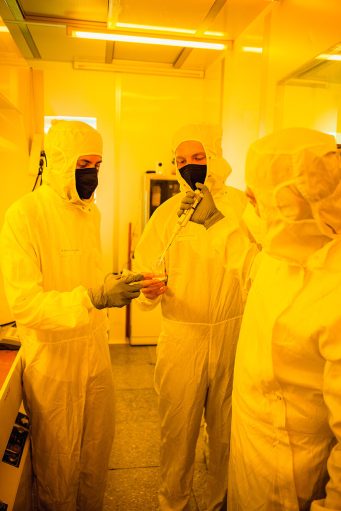
Discover the world of microprocessors, their programming, integrated circuit design, and the endless possibilities of their applications. Dive into the micro- and nanocosmos of semiconductors, computer simulations, and the use of AI for modeling. If you are curious about what powers electric vehicles, this is where you belong!
- You will learn how to design, build, and apply electronic circuits and systems across various fields of electronics, photonics, and electronic communications.
- You will learn to work with audio-video, radio, optical, and bio signals. Terms such as nanoelectronics, integrated circuits, power electronics, intelligent sensors, organic electronics, and optoelectronics will no longer be unfamiliar to you.
- You will be able to use and explore Internet of Things (IoT) systems.
- You will be an expert in electronics and electronic systems across various industries, and you will also be well equipped for roles in computer science or automation—essentially anywhere electronics are used.
- You will be able to pursue a career in science and research not only in Slovakia, but across Europe and worldwide.


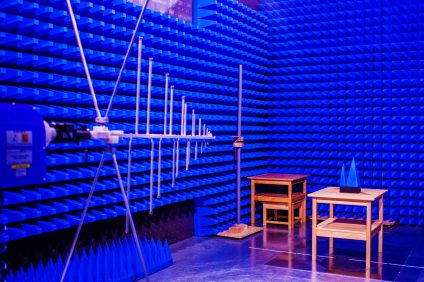

If we were in The Big Bang Theory, we’d be Howard. Simply put, we understand the theory and aren’t afraid to get our hands dirty with practice. We connect wires and see electrons flowing through them.
- During your studies, you will gain knowledge of various digital and analog circuits, electromagnetic fields, as well as the basics of programming. You will learn to work with many professional simulation and design tools and gain hands-on experience with advanced measurement instruments.
- Through elective courses, semester projects, and final theses, you will choose the area in which you want to develop further.
- You can become a designer of electrical engineering systems, a developer, or a tester. You will be in high demand in industries related to electrical engineering, electronics, and circuit technology, as well as in related fields such as IT.
- By completing the bachelor’s degree, you will gain a solid foundation for continuing your studies at the master’s level in Applied Electrical Engineering.

Voice messages, FaceTime calls, direct messages. Sound, image, and text. How can they be recorded, transmitted, and played back? They are all data, and in this field you will learn how to work with them.
- You will learn how to design, build, and operate information and communication systems and networks. Are you interested in the Internet of Things, 5G+ networks, optical communications, or the Metaverse? Go for it! You will be able to work independently as well as in a team and learn how to manage projects. Of course, you can also continue your studies at the master’s level.
- Application programmer, ICT project manager, database administrator, information system administrator, or system programmer. You will also find opportunities in various companies and organizations that use information and communication technologies, as well as in the fields of business and marketing.


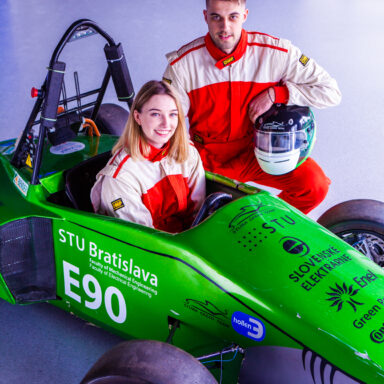
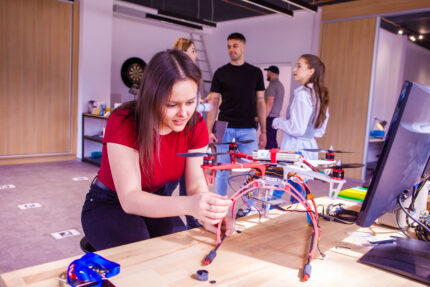

An autonomous electric Tesla vehicle, a space rover, a drone, a personal assistant connected to the Internet of Things, an intelligently controlled production line. What do they have in common? They are all mechatronic systems!
- Information and practically oriented knowledge drive today’s digital world. How can all of this be managed? We offer you a field of study where it’s possible. Mechatronics combines computer science, electronic systems, automation, and mechanics using intelligent technologies.
- Are you interested in the use of digital technologies and automatic control? Would you like to program your own smart device equipped with artificial intelligence, visualize it in virtual reality, or present it in the metaverse? Choose the path of a modern study focus called “Intelligent Technologies and Systems”.
- Do you want to know how hybrid vehicles and electric cars work? Are you intrigued by autonomous vehicles and transportation? If you are interested in automobiles, the digitalization of their production, or hydrogen technologies, then the focus “Automotive Mechatronics and Electromobility” is made just for you.
- Our flexible study program offers unmatched freedom in choosing courses. After mastering the basics, you can select from a wide range of subjects what truly interests you. As you grow professionally, you can further narrow your focus, specialize, and choose a career that suits you best. Broad knowledge in the field of mechatronics naturally prepares you to become a team leader or a manager of innovation projects.
- You will be in demand in areas where hardware and software come together. You will apply your skills in programming and the development of intelligent devices based on modern electronics and advanced software technologies.
- You can pursue a career as a designer and architect of mechanical components using state-of-the-art prototyping and simulation tools as well as digital twins.
- You will become part of the 21st-century industrial revolutions known as Industry 4.0 and 5.0. Thanks in part to you, production in intelligent digital factories will support efficient collaboration between humans and machines, ensuring long-term sustainable and environmentally friendly manufacturing.
- You will become an architect of automotive safety systems and a developer in the fields of autonomous vehicles or machine vision. You will understand the latest trends in electromobility and hydrogen technologies.

Eliminate emissions, supply energy to the entire world, save human lives, or explore materials using particles. Become the new Oppenheimer—with a happy ending.
- You will gain solid knowledge of mathematics, general and nuclear physics, electrical engineering, and materials science. In addition, you will also learn the basics of computer science.
- You will learn everything about the physical processes taking place in various materials, as well as how to measure and diagnose them. You will understand the safe design, operation, and decommissioning of nuclear facilities. You will also learn the principles of particle propagation through matter and how to apply them in research or medical equipment.
- A bright future awaits you in the field of nuclear energy. Nuclear power is a significant part of the energy mix in Slovakia and Europe and has a clear role in the future, as it is considered a clean energy source. You can build, manage, and decommission power plants, handle nuclear waste and its decontamination, or manage projects in this field.
- You can also apply your acquired knowledge in materials research or industry, as well as in the field of nuclear medicine or radiation protection.
- After completing the bachelor’s degree, you will also have a clear pathway to continue with master’s (engineering) studies.

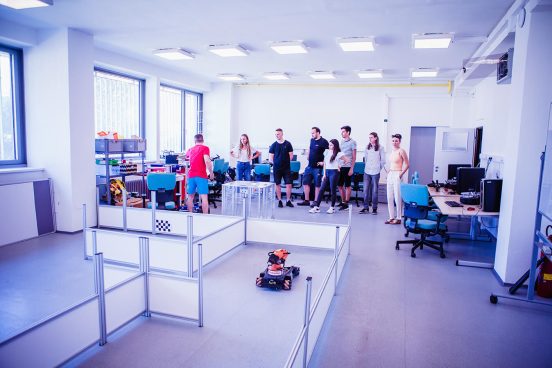
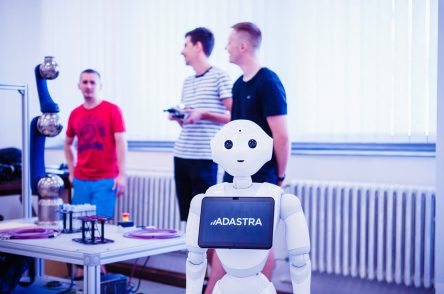

We are fascinated by everything we see come to life—from small drones and autonomous cars to massive transportation systems that run entire cities. Do you belong with us?
- You will learn how to design, build, program, and control various robotic systems, industrial robots, and manipulators. You won’t focus only on robot programming, but also on sensor technologies that allow robots to perceive their environment. You will not only train yourself, but also artificial intelligence, which is an essential part of modern robotics. In addition to theoretical knowledge, you will have the opportunity to gain hands-on experience through practical exercises at the National Robotics Center and in modern laboratories.
- You will find career opportunities in the deployment, operation, and programming of automation and information systems across various fields—especially in manufacturing, but also in services, transportation and energy infrastructure, administration, ecology, healthcare, intelligent buildings and homes, science and research, as well as mobile applications. You can also smoothly continue your studies at the master’s (engineering) level.

You can’t add anything cooler to your résumé. After completing a bachelor’s degree in any of our fields, you can study Space Engineering at the master’s level. Control a Mars rover, study black holes, and uncover the secrets of the very existence of the universe. The answer is 42.
- This program is offered at the master’s (engineering) level, so you will already bring a strong set of practical skills from your bachelor’s studies.
- In addition, you will focus on engineering technologies used primarily in high-performance space and aerospace systems and applications. This includes advanced electronic, sensor, robotic, and propulsion systems. In their design, you will use the latest technologies and artificial intelligence.
- You will gain knowledge in astrophysics, astrodynamics, astrobiology, as well as the mechanics and thermodynamics of space systems—allowing you to understand the universe and continue exploring it.
- You can become a designer, architect, and developer of space technology systems or microsatellites. You may create new software, products, components, or even entire companies that help us explore—or one day finally inhabit—space.
- If you prefer to stay on Earth, you will also find opportunities in advanced electronic systems, as well as in robotics, mechatronics, IT, transportation, and energy. A wide path in science and research is also open to you.